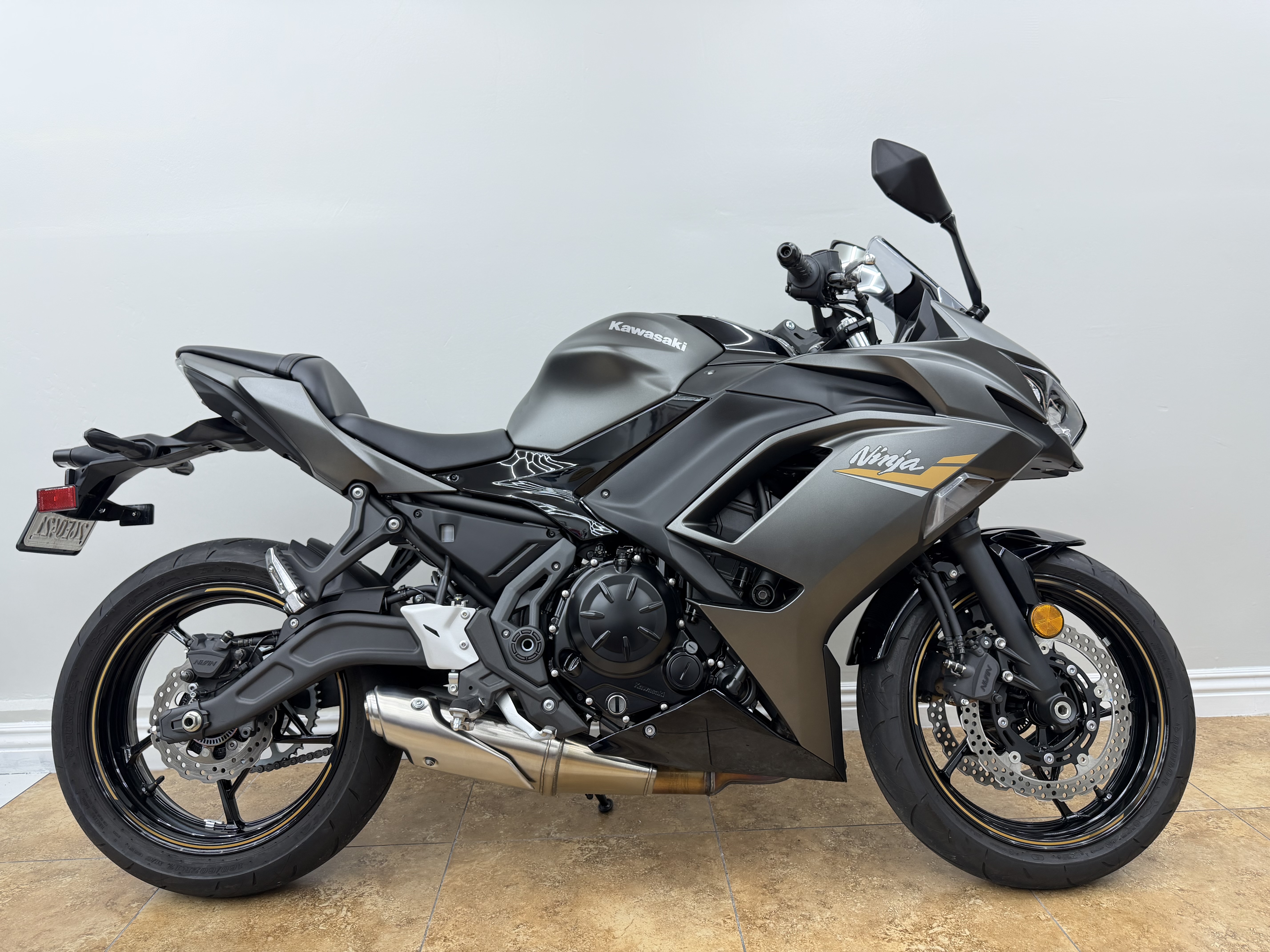


– One Owner, Clean Title, Pristine Condition!
– Only 5,200 miles!
– New Tires Front & Rear!
– Lowered 2 inches! PSR Kickstand added!
– Fender Delete & Turn Signal Upgrade!
– ABS! (Only KRT Edition 2022’s have ABS)
Related
Featured Options
- Electronic rider aids:Kawasaki Traction Control (KTRC), Power Mode, and Kawasaki Quick Shifter (KQS)
- Performance:41 mm inverted Showa SFF-BP fork with top-out springs, stepless compression and rebound damping, and adjustable spring preload
- Transmission:6-speed, return shift
- Engine:636cc, 4-stroke, in-line four, DOHC, 16-valve, liquid-cooled
- Final drive:Sealed chain
- Riding modes:Three modes: Sport, Road, and Rain
- Multi-function LCD screen:Advanced electronics
- Quick shifter:Allows for clutchless upshifts and downshifts
- Launch control: Part of the Race Tools Package, this feature allows you to set a Launch RPM and Ramp Parameters
- Engine: 636cc, liquid-cooled, 4-stroke, DOHC 16-valve in-line four
- Power: 134 hp at 13,500 rpm
- Torque: 52.3 lb-ft of torque at 11,000 rpm
- Curb Weight: 430 lbs (195 kg)
- Seat Height: 32.7 in (830 mm)
Overview
2022 Kawasaki Ninja ZX-6R Features
Assist & Slipper Clutch
Under normal operation, the assist cam functions as a self-servo mechanism, pulling the clutch hub and operating plate together to compress the clutch plates. This allows the total clutch spring load to be reduced, resulting in a lighter clutch lever feel when operating the clutch.
When excessive engine braking occurs – as a result of quick downshifts (or an accidental downshift) – the slipper cam comes into play, forcing the clutch hub and operating plate apart. This relieves pressure on the clutch plates to reduce back-torque and helps prevent the rear tire from hopping and skidding. This race-style function is particularly useful when sport or track riding.
Dual Throttle Valves
Late-model sport bikes often use large-bore throttle bodies to generate high levels of power. However, with large diameter throttles, when a rider suddenly opens the throttle, the unrestricted torque response can be strong. Dual throttle valve technology was designed to tame engine response while contributing to performance.
On models with dual throttle valves, there are two throttle valves per cylinder: in addition to the main valves, which are physically linked to the throttle grip and controlled by the rider, a second set of valves, opened and closed by the ECU, precisely regulates intake airflow to ensure a natural, linear response. With the air passing through the throttle bodies becoming smoother, combustion efficiency is improved and power is increased.
Economical Riding Indicator
Using high-precision electronic control for engine management, Kawasaki models can achieve a high level of fuel efficiency. However, fuel consumption is greatly affected by throttle use, gear selection, and other elements under the rider’s control. The Economical Riding Indicator is a function that indicates when current riding conditions are consuming a low amount of fuel. The system continuously monitors fuel consumption, regardless of vehicle speed, engine speed, throttle position and other riding conditions. When fuel consumption is low for a given speed (i.e. fuel efficiency is high), an “ECO” mark appears on the instrument panel’s LCD screen. By riding so that the “ECO” mark remains on, fuel consumption can be reduced.
While effective vehicle speed and engine speed may vary by model, paying attention to conditions that cause the “ECO” mark to appear can help riders improve their fuel efficiency – a handy way to increase cruising range. Further, keeping fuel consumption low also helps minimize negative impact on the environment.
KTRC (Kawasaki Traction Control)
KTRC, Kawasaki’s advanced traction control system provides both enhanced sport riding performance and the peace of mind to negotiate slippery surfaces with confidence. Multiple rider-selectable modes (the number of modes varies by model) offer progressively greater levels of intrusion to suit the riding situation and rider preference.
Less intrusive modes maintain optimum traction during cornering. Designed with sport riding in mind, they facilitate acceleration out of corners by maximizing forward drive from the rear wheel. And because Kawasaki’s sophisticated software bases its dynamic analysis on the chassis’ orientation relative to the track surface (rather than relative to a horizontal plane), it is able to take into account corner camber, gradient, etc., and adapt accordingly.
In the more intrusive modes (and for some models, in any mode), when excessive wheel spin is detected, engine output is reduced to allow grip to be regained, effectively enabling riders to negotiate both short, slippery patches (train tracks or manhole covers) and extended stretches of bad roads (wet pavement, cobblestone, gravel) with confidence.